
About the Client
Agricultural process automation didn’t start at Belaunzaran SA as a technology project. It started as a management problem: a farming company with fields spread across different regions, making production and purchasing decisions based on information that arrived weeks after the fact. The operation worked — the jobs got done, the inputs were applied, the harvest came in — but the data behind that operation was consolidated long after the productive event had already happened.
The starting point: accounting software is not a management system
The only software in use was administrative: recording tax and accounting documentation. It was built for compliance, not for decisions.
That left leadership without fast answers to basic questions about the business:
- What work was actually performed in each plot, and when?
- Which product was applied, at what rate, and with which machinery?
- How much inventory is left today at each field?
- What is the accumulated cost per plot for this season?
Time lag as a hidden cost
In agriculture, late information isn’t just an administrative annoyance. It’s a purchase order sized on the wrong assumptions, inventory showing up where nobody expected it, a cost per hectare that only becomes visible once it can no longer be corrected. The lag never appears in the P&L under its own name — but it gets paid all the same.
One operating ecosystem as the single source of truth
We configured monday.com as the operating system for all field work and management, with automations built around how the company actually works. The core decision was simple: one single place where a work order is created, executed and closed.
The work order as the unit of control
Every task becomes a work order sent to the contractor, supplier or in-house field staff. That order specifies exactly what work is to be done, with which machinery, and which product should be consumed in each plot.
Closing the loop in the field: the same link that assigns, confirms
This is the heart of the design. When the job is finished, the person who did it confirms the data through the same link they received: work performed, inputs actually applied, machinery used. No parallel spreadsheets, no follow-up calls, no duplicate data entry back at the office.
The result is immediate: the status of every plot at every field, the products used and the input inventory on site are all updated in the system in real time. This form of agricultural process automation removes the single step that consumed the most time and generated the most errors — manually transcribing what happened in the field.
AI applied to the back office: invoices and delivery notes that enter themselves
We added automated PDF reading of invoices and delivery notes using AI and AI agents: the data is extracted and recorded directly in the system, with no manual entry.
That closes the loop between the administrative side and the productive side. A delivery note stops being a piece of paper somebody types up three days later and becomes an inventory movement recorded on the spot, reconcilable against the consumption declared at each plot.
From data to dashboards: permanent management visibility
With information flowing in real time, we built dashboards so leadership always has the picture of the business available:
- Hectares planted by crop
- Costs and expenses by plot and by season
- Input consumption and current inventory by field
- Harvest recorded and yield by plot
Leadership stopped requesting reports and started watching dashboards. It’s the difference between managing through the rear-view mirror and managing through the windshield.
The real challenge wasn’t technical — it was adoption
The project’s risk hypothesis was the usual one for this kind of transformation: that people wouldn’t use it. Field staff, contractors, machine operators.
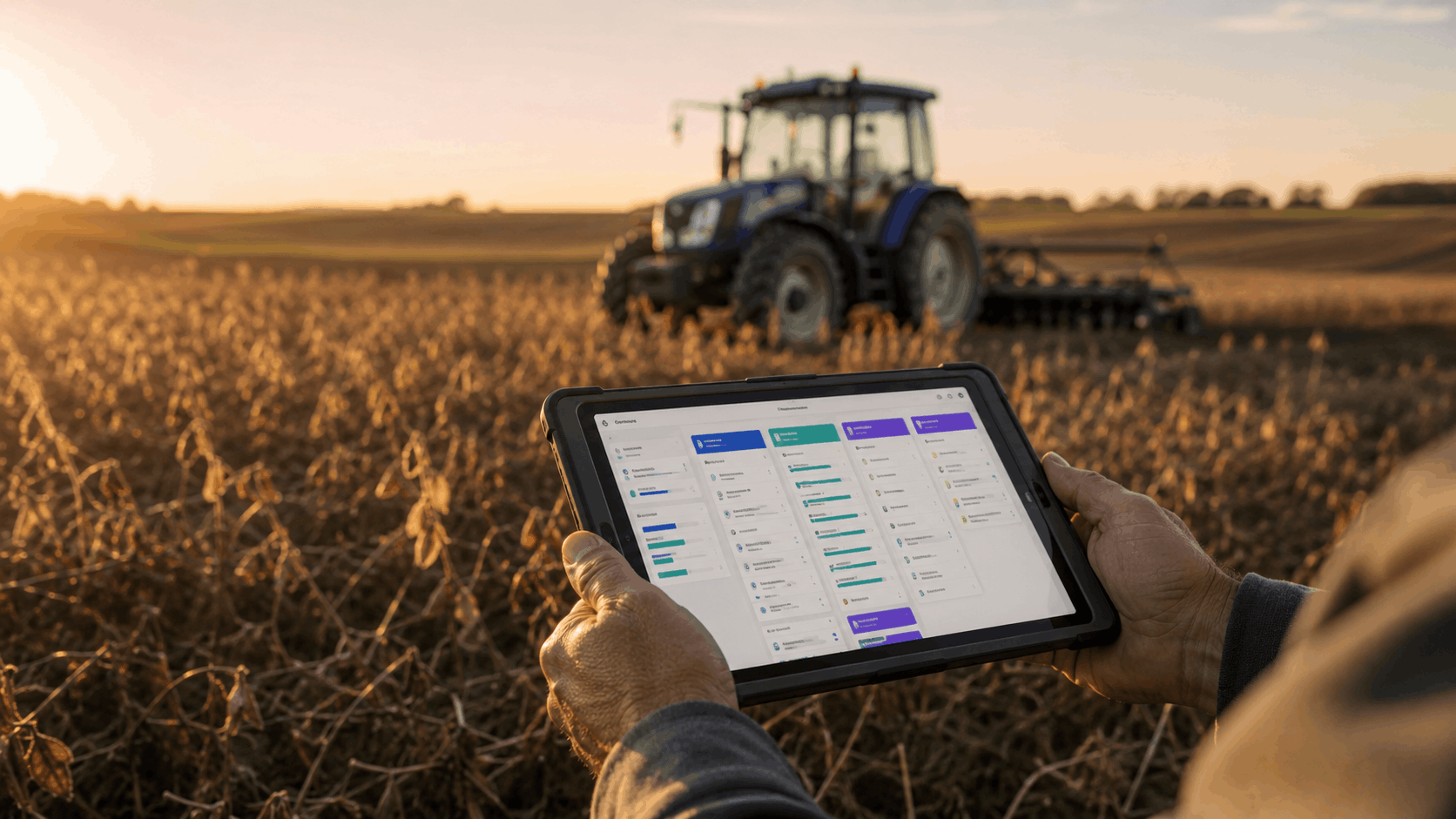
The opposite happened. Because the system was built around the company’s actual working habits — and not the other way around — rollout and adoption were a success across the entire workforce. Teams adopted tablets and phones in the fields and in the tractors as everyday work tools, which in turn increased operational efficiency and produced a real digital transformation rather than a declared one.
That’s the point most often underestimated in an agricultural process automation project: technology doesn’t fail for lack of power, it fails from friction.
Results
| Indicator | Improvement |
|---|---|
| Timely data and information visibility | +75% |
| Reduction in time spent on manual tasks | -50% |
| Clear, accurate and timely internal communication | +45% |
Belaunzaran SA went from a system that recorded the past to a system that governs the present: every plot, every input, every cost and every yield, visible the moment they happen.
At The Automation Partner we are official monday.com partners and we work specifically with companies between 20 and 500 employees that have reached the scale where operations no longer fit in a spreadsheet. If your agricultural business manages multiple fields, coordinates contractors, tracks input inventory from memory, and only learns its cost per hectare once the season is over, the problem isn’t a lack of data: it’s that the data doesn’t arrive on time or in the right place. We design and implement the operating system your business needs, built around how your people actually work.
Book a free strategy consultation → CLICK HERE TO SCHEDULE