
AI Operational Scaling Model: how to move from your first AI win to an operating model
The nine dimensions behind companies that scale AI, a way to see where yours stands and what to do in the next 30 days.
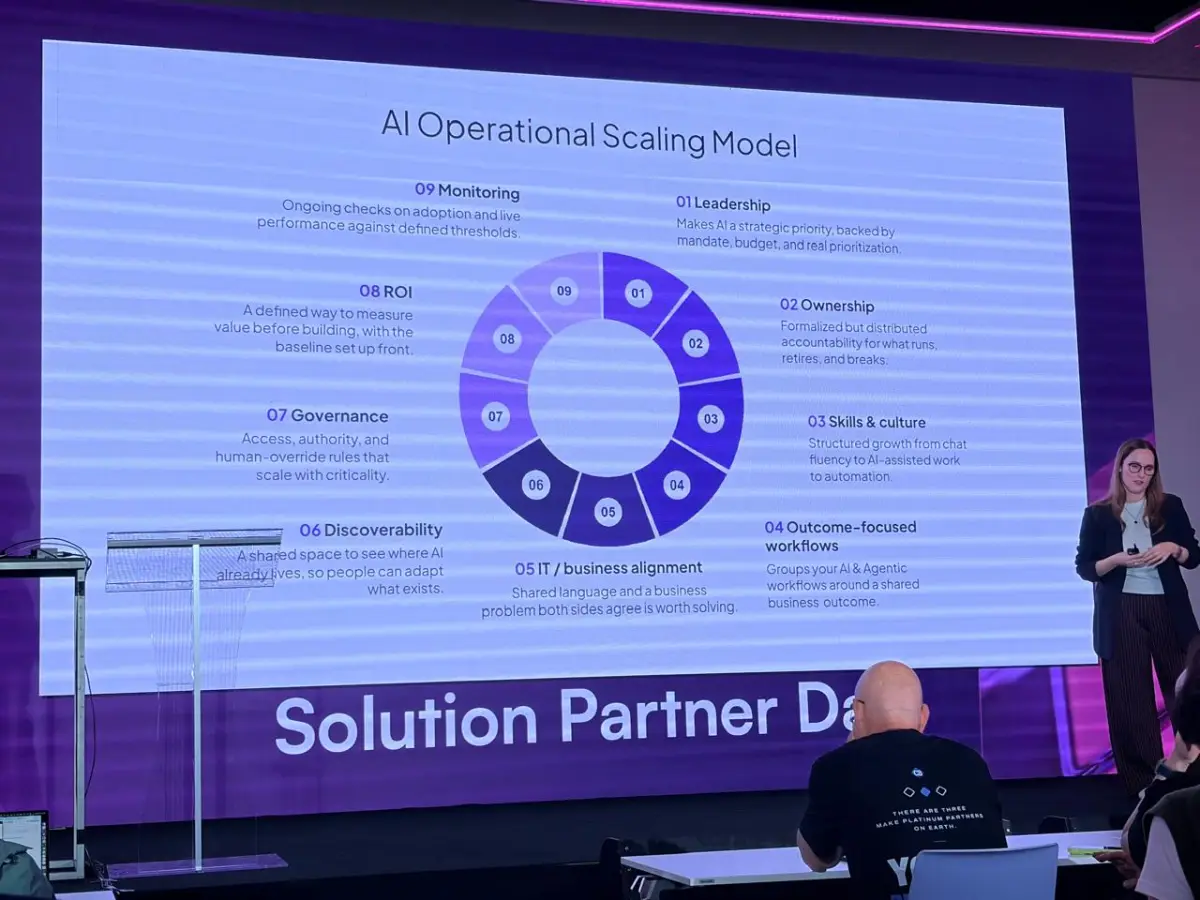
The AI Operational Scaling Model is a framework from Make’s research report The Mid-Market AI Adoption Journey. It says AI stops being a set of scattered experiments and becomes part of how a company runs when nine things connect: leadership, ownership, skills and culture, outcome-focused workflows, IT and business alignment, discoverability, governance, ROI and monitoring. None of them is enough alone. This guide explains each one in plain language, how to tell whether it is missing in your company and where to start.
Where this comes from
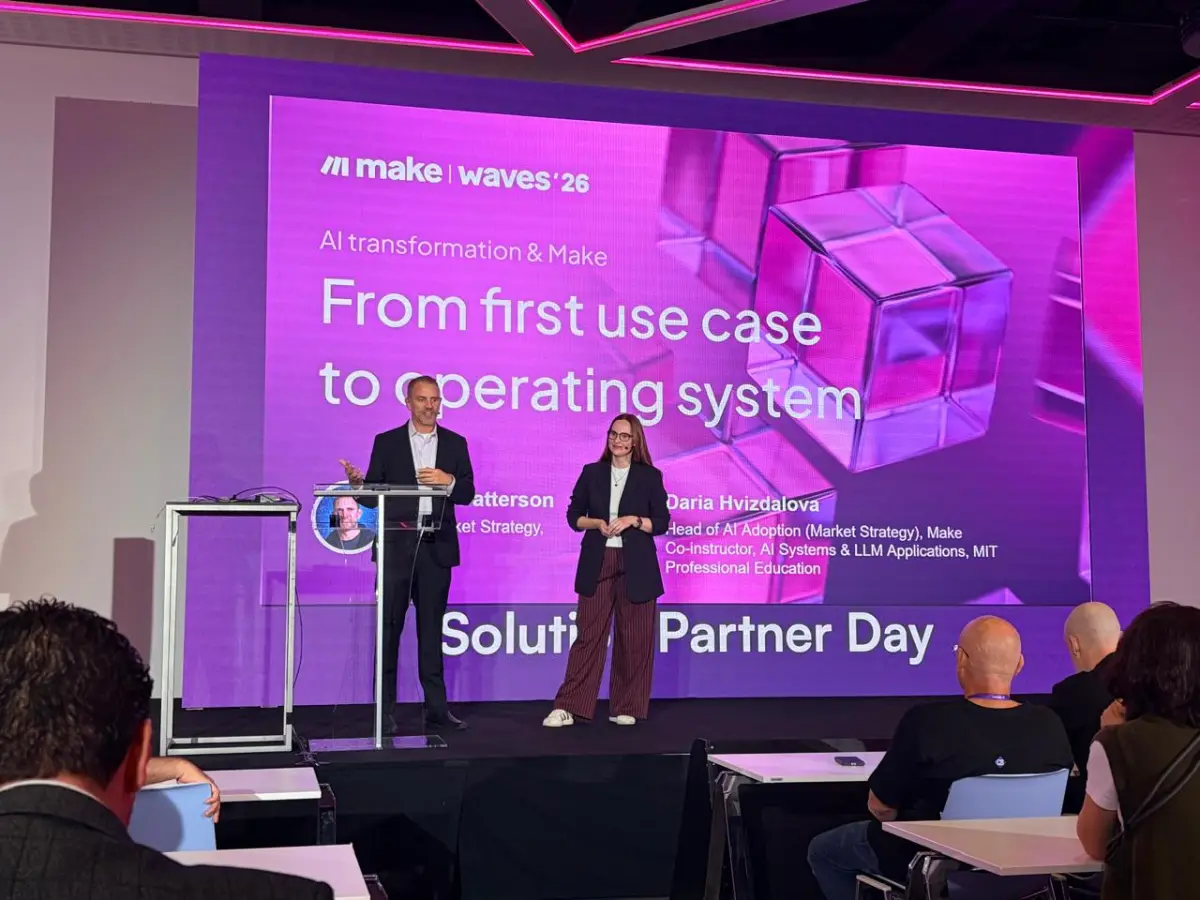
Daria Hvizdalova (Head of AI Adoption at Make) and Darin Patterson (VP of Product Advocacy and Market Strategy at Make) presented the model at Solution Partner Day, during Make Waves ’26 in Prague, based on the report they wrote with Yana Shamina. The report is free: you can get it from Make’s report. The framework and the data belong to Make. The reading of it, the examples and the checklists are ours, and we say so when we add our own view.
Who writes this
The Automation Partner is a certified Make partner that builds systems on monday.com and Make for mid-sized companies. We use this framework as a lens on what we see in our projects, not as something we invented. Make designed it for companies of roughly 250 to 1,000 people. We work with companies between 20 and 1,000 people, and the section for smaller companies covers smaller teams.
What the AI Operational Scaling Model says
Make’s researchers started from a question most AI studies skip: what happens inside a company after the first useful AI use case appears? Who owns it? Who decides what comes next? Why do some organizations scale quickly while others stay stuck in disconnected experiments?
Their answer is that the hard step is not starting with AI, and it is not even making one use case work. The hard step is turning several working use cases into an operating model: workflows grouped around a result, dependencies between them, clear ownership, governance, ROI and a view that crosses functions. The AI Operational Scaling Model is the checklist Make built from that finding. It has nine dimensions, and the report is explicit that none of them is enough alone.
Many companies are not blocked for lack of ideas. They are blocked because they have too many disconnected ideas, too many local experiments and not enough view of the end-to-end value chain.
Why AI stalls after the first win
Adoption numbers are high enough that the useful question is no longer whether companies try AI, but what kind of adoption those numbers describe. The report gathers the evidence, and we repeat it here with the sources Make cites. Check the originals before reusing any figure.
That last row comes from a study Make commissioned, with 540 respondents across 16 industries and more than 35 countries. Make itself calls it directional evidence and not a global benchmark, so read it as a signal. The same study found that personal AI automation averages around 26% and organizational AI automation around 25%: AI is present in daily work, but it is still used more to help individuals than to run structured workflows.
That is the pattern behind the model. The report describes three stages. In the first, individual productivity, people use chat tools and copilots to work faster. In the second, repeatable workflows, an AI use case runs reliably inside one team or function. In the third, an operating model, workflows are owned, governed and connected across functions. Most organizations sit between the first and the second, and the third is still rare in practice.
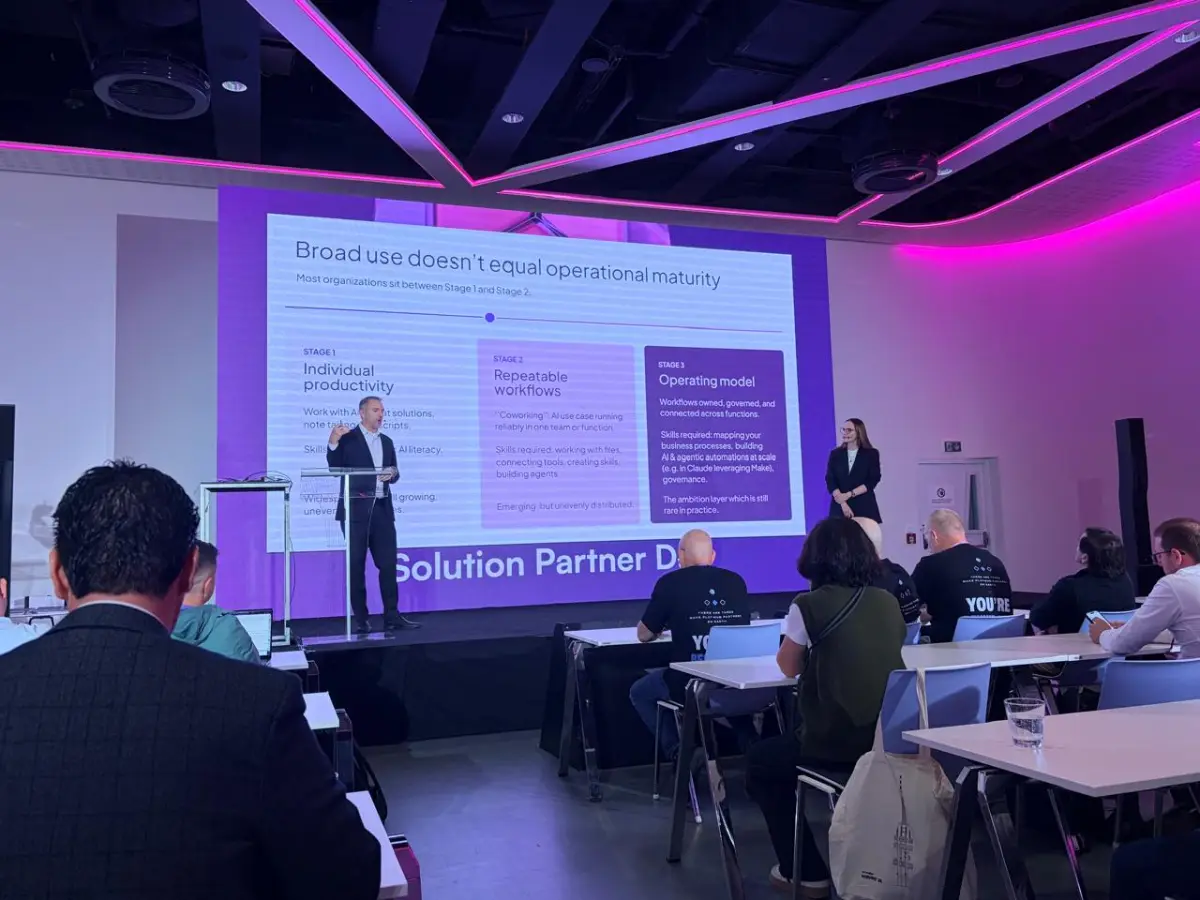
Moving from the second stage to the third is what the AI Operational Scaling Model is for.
The nine dimensions of the AI Operational Scaling Model at a glance
Here are the nine dimensions in the order Make presents them. The first two columns follow the report. The third one is our own reading from projects: signals we look for when a dimension is missing. It is not part of Make’s framework.
| Dimension | What it means | Signal it is missing (our reading) |
|---|---|---|
| 01 Leadership | AI is a strategic priority with a mandate, a budget and real prioritization | Everyone is told to “use AI”, but nobody decides what gets done first or what gets pushed back |
| 02 Ownership | Formal but shared accountability for what runs, what gets retired and what breaks | The only person who understands an automation is whoever built it |
| 03 Skills and culture | Structured growth from chat fluency to AI-assisted work to building and governing automations | AI training was a single workshop, once |
| 04 Outcome-focused workflows | AI and automations grouped around a shared business result | You have a list of automations by tool, not by outcome |
| 05 IT and business alignment | A shared language and a business problem both sides agree is worth solving | IT finds out about automations when they break, and business teams wait for IT for everything |
| 06 Discoverability | A shared space to see where AI already lives, so people can reuse and adapt it | A team asks “has anyone done this before?” and nobody knows |
| 07 Governance | Access, authority and human-override rules that scale with how critical a workflow is | Nobody can say what a workflow is allowed to touch or who can turn it off |
| 08 ROI | A defined way to measure value before building, with the baseline set up front | Success is described as “it feels faster” |
| 09 Monitoring | Ongoing checks on adoption and live performance against defined thresholds | Errors are found by customers, and nobody checks whether the thing is actually used |
The sections below follow the order that tends to matter in practice: leadership and ownership first, because without them the rest has no one to carry it.
Leadership: permission, pressure or priority
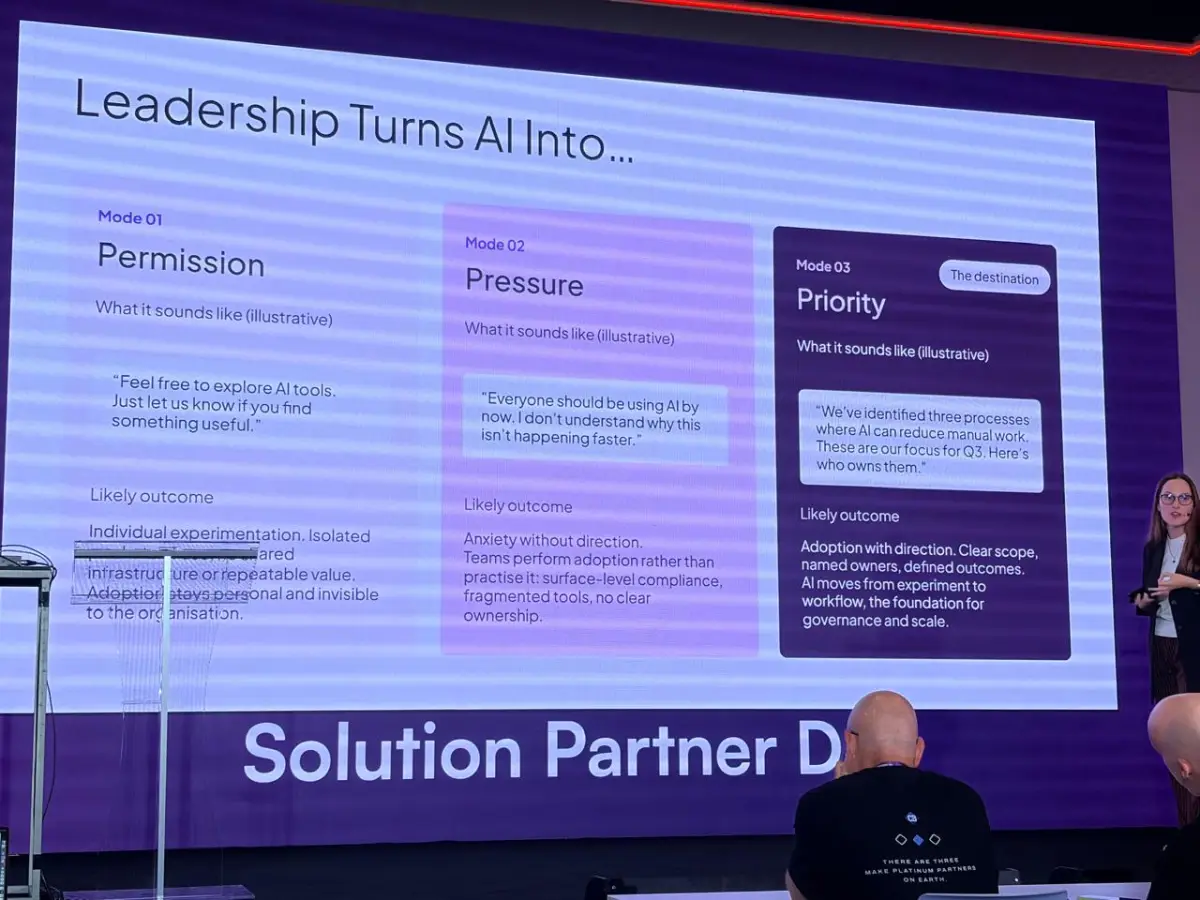
Leadership was one of the strongest patterns in Make’s qualitative research. It is not only sponsorship. The signal a leader sends decides whether AI stays a private experiment or becomes a governed workflow. The report names three modes:
Permission. “Feel free to explore AI tools.” The likely outcome is individual experimentation: isolated pockets of use, no shared infrastructure, adoption that stays personal and invisible to the organization. Pressure. “Everyone should be using AI by now.” The outcome is anxiety without direction: teams perform adoption instead of practicing it, with surface-level compliance and fragmented tools. Priority. Leadership names the processes where AI can reduce manual work, sets the focus for the quarter and says who owns each. That is the destination, because it comes with clear scope and defined outcomes.
One variant is worth knowing. When senior leaders lack AI fluency but name a credible internal translator, such as a head of AI or an automation lead, and genuinely back them, the effect can mirror priority. It only works when that person has real mandate and not just a title. And the report warns that if everything depends on one champion, adoption tends to stall when that person leaves or changes role.
A quick test
Can you name the three processes where AI is expected to reduce manual work this quarter, and the person who owns each? If you cannot, you are probably in permission or pressure mode. Leadership is the dimension that decides what the other eight are for.
Ownership: three questions before a workflow becomes critical
AI ownership is not one role. It changes with the path your company follows. Bottom-up adoption brings energy and relevance, but also shadow AI, duplicated tools and fragile workflows that disappear when someone leaves. Top-down adoption brings direction and governance, but can produce artificial projects if employees do not pull. The most mature pattern in the report is a hybrid: ideas come from the teams, supported by a common center of excellence, with local prioritization inside guardrails.
The report also gives a practical trigger for formalizing ownership: when a workflow failure affects someone who did not build it. A broken personal automation is an inconvenience. A broken workflow that a sales team uses for daily outreach, or a finance process that feeds a weekly report, is an organizational problem.
Is it an organizational capability, or personal productivity?
The report suggests three tests for any AI workflow. A workflow that fails all three is personal productivity, not an organizational capability, and it belongs in an experiment log.
Does it repeat?
It runs more than once and produces the same kind of output.
Does it have an owner?
A named person (and a backup) is responsible when something breaks, with enough authority to prioritize its maintenance.
Can someone else see its output?
Its results are visible to someone other than the person who built it.
Naming an owner sounds small. It is the difference between a workflow the company owns and one that depends on whoever built it.
Processes by outcome, not by tool
The report gives a clear example. A sales team that has separately automated prospect research, CRM history review and outreach drafting does not yet have an AI-powered business process. It has three tools. The shift happens when someone steps back and asks what the end-to-end value chain is, what dependencies exist between those workflows and what outcome the team is trying to produce together.
So the model asks you to group AI and automations around a recurring outcome: everything that moves a lead through qualification, everything involved in resolving a support ticket, everything from invoice to payment. Managed that way, workflows are easier to govern, to hand off and to improve as a whole. Grouping is also a prioritization decision: some experiments should stay local, and some should be retired.
What this looks like in a real project
Kids in the Game, a youth organization we have worked with (see the published case), did not start with an “AI project”. We started with specific use cases, such as keeping registrations in sync and sorting support emails, and kept extending the work to other areas. In the snapshots we review together, the number of automations running grew from 21 to 33 across three measurements. The point is not the number: it is that we review it together, as a whole.
That last part connects the next sections, because a growing list of automations only becomes an operating model if it is measured, governed and visible.
Where does your company stand on these nine dimensions?
Take the tech maturity assessment and get a personalized report with your opportunities and where it makes sense to begin.
Take the assessmentROI that matures with the company
Early AI ROI is usually calculated in familiar terms: time saved, tasks completed faster, tool costs offset by productivity. That is a good start, but it is not enough once AI reaches workflows that cross teams. The report lists what ROI starts to include: process quality, fewer handoffs, faster decisions, better customer outcomes, capacity and revenue gained, avoided costs, competitiveness and organizational learning.
The dimension itself is about when you measure. Make asks for a defined method to measure value before building, with the baseline set up front. If you only look afterwards, you end up reconstructing what the process used to cost, and the numbers lose credibility.
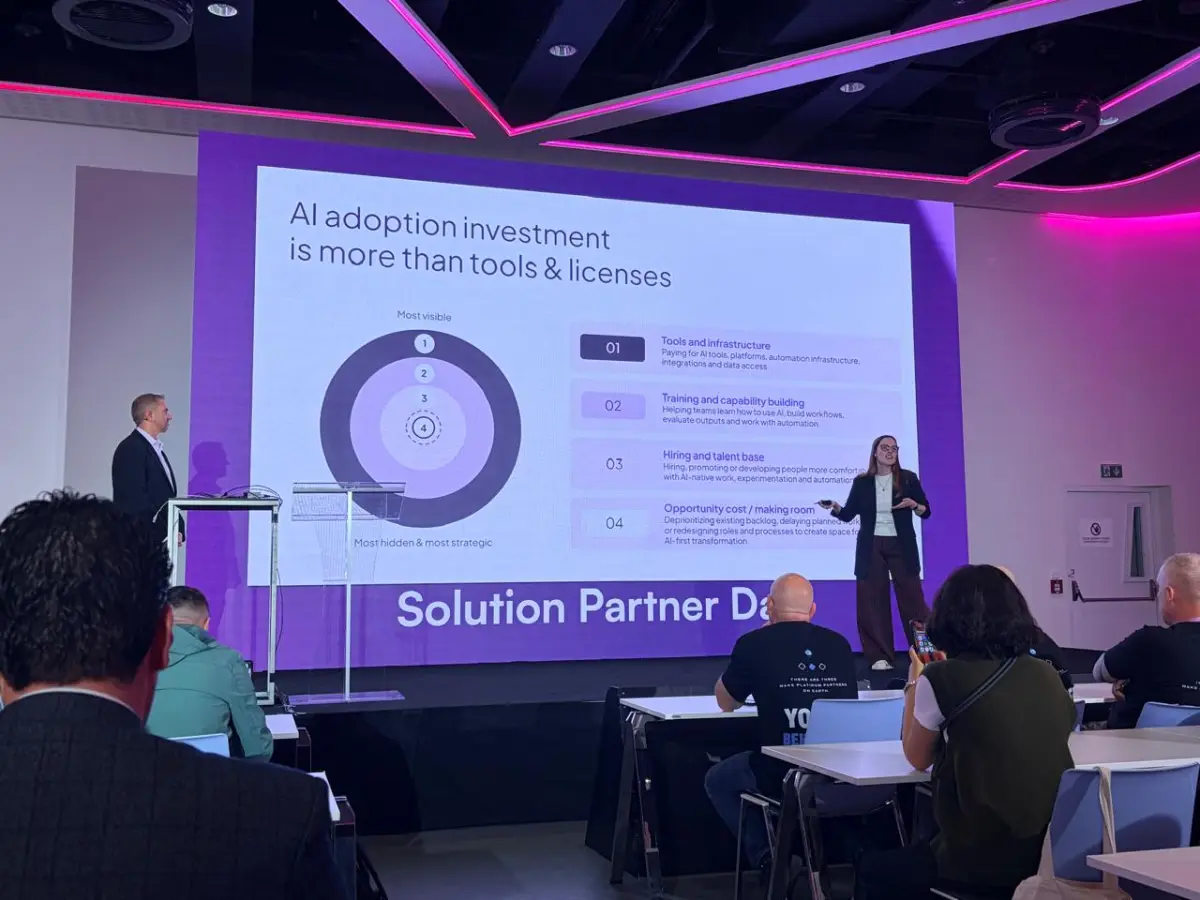
The same session made a point that is easy to miss: the investment in adoption goes beyond tools and licenses. Besides infrastructure, it includes training, hiring and development of people who are comfortable with AI-native work, and the opportunity cost of deprioritizing existing work to make room. The most hidden layers are also the most strategic.
An example, with its limits
In the Kids in the Game snapshot we record the estimated hours saved per month by each group of automations. The estimates add up to roughly 130 hours a month across seven groups of automations, some of them seasonal. They are estimates and not an audit, and we present them that way. In the public case, one of those automations is linked to savings of up to USD 15,000 a year. The useful habit is not the figure: it is having an estimate per automation, recorded when it goes live.
Governance and monitoring: start small, grow with criticality
Governance, in Make’s model, covers data access rules, decision authority, conditions for human override, regulatory classification and incident response. The key idea is that it starts small and scales in proportion to how critical a workflow is. A robust version includes a working group with visibility across functions, often called a center of excellence, that collects what teams are actually doing, checks how scalable and reliable it is and turns the patterns into shared standards.
The report is firm on how to frame it: governance should clarify what can be tried, what can be scaled and what needs human review, and it should not create bureaucracy that kills momentum. It is an enabler, not a late compliance add-on.
Monitoring is the other half. Once workflows go live, technical monitoring catches failures and tells you when something needs adjusting, and adoption monitoring shows whether people actually use what was built and what that use costs. Both feed back into ownership and governance.
An example from a project
With Kids in the Game we also monitor AI usage (credits and tokens) and the cost of the platforms involved, so that growth in usage never comes as a surprise. We do not publish those figures, but we track them, because usage grows quietly.
IT and business alignment, discoverability and skills
IT and business alignment
The report puts the starting point of success in a business problem that both sides agree is worth solving, and not in the choice of technology. Business teams need context and autonomy to build. IT needs visibility to connect what is built to the rest of the stack. When either side is missing, you get shadow tools on one end and bottlenecks on the other.
Discoverability
People do not want to be the first to try something. They want to see what others did, understand how it worked and adapt it. Without a shared space where AI usage is visible, AI stays in the realm of personal productivity. The report lists simple ways to build that visibility: shared experiment logs, tool workspaces, an “AI wins” channel, recurring demo meetings, hackathons and informal maps of problems already solved.
Skills and culture
Training matters, but it needs a full ladder: from chat fluency to AI-assisted work to building and governing automations. Beyond formal programs, regular touchpoints help: updated resources, internal showcases and space to share what works and what does not. The report also describes a role that appears when local workflows start to become a portfolio: the “business engineer”, or AI and automation lead, who sits between the business owner, the process analyst and the technical builder.
The snapshot we review with Kids in the Game touches these dimensions at once: one shared view of what is running and what it is saving.
Agents or simple automation?
Agentic ambition is running well ahead of agentic readiness. The report cites a gap between how many companies aim to run agents and how many do.
The report’s qualitative work points to a practical distinction. Deterministic tasks do not need an agent: categorizing costs from bank statements is a rule, and simple automation is enough. Agents become relevant when a task requires judgment, context and several sources of information, for example a sales agent that reviews a prospect’s website, checks fit with the ideal customer profile, looks at CRM history and drafts outreach.
The nine-point action plan in the report asks leaders to decide on purpose whether to build toward agentic work gradually or right away. AI-ready companies can start agentic. Others should begin with familiar workflows and move step by step. Both are valid. What is not valid is adding agents to workflows nobody has redesigned. This is also the point of our earlier guide on what to automate next: measure first, then decide between a fixed rule and an agent, step by step.
A 30-day plan to put the model to work
These timeframes are ours, not Make’s. They assume one person with a few hours a week and the support of someone from leadership.
Diagnose the nine dimensions
Score each one from 0 (not in place) to 2 (working). Ask people from different layers of the company, not only leaders: the report warns about leadership bias. Pick the two lowest scores that block the rest, usually leadership or ownership.
Choose one outcome and map its workflows
Pick a recurring result (qualified lead, resolved ticket, invoice to payment) and list the AI uses and automations that touch it today. Mark which ones stay local, which are grouped and which get retired.
Name an owner and set the baseline
One owner and a backup for that outcome. Record how long and how much it costs today, and which indicator will tell you that it improved.
Make it visible and set a review
Create one shared place to see what runs and who owns it, and put a recurring review on the calendar covering performance, usage and cost. Decide what the next outcome is.
If your company has fewer than 250 people
Make designed the model for larger mid-sized companies, roughly 250 to 1,000 employees. That range is blended into enterprise statistics most of the time. The report cites Eurostat for the EU in 2025: AI technologies were used by about 17% of small enterprises, 30.36% of medium ones and 55.03% of large ones, where “large” means 250 or more employees. So size helps adoption, but the report is clear that it does not explain how deep adoption goes. Proximity to AI, leadership, ownership and governance matter more.
We work with companies from 20 to 1,000 people, so we adapt the model. These adaptations are our judgment and not part of Make’s report:
- Ownership can be one person and a backup. It does not need a committee.
- Governance can fit on one page: what each workflow can touch, what needs approval and who can turn it off.
- Discoverability can be a shared document or a channel, as long as it is up to date.
- The baseline and the owner do not shrink with the company. Without them, even a ten-person team ends up with disconnected experiments.
If you do not know which dimension is the bottleneck, the quickest way to see it is to run the assessment above and talk it through. You can also read the full report on Make’s site: it is free, and it includes the sources behind every figure we mention here.
Tell us how your operation runs and we will help you see which of the nine dimensions is holding you back
Thirty minutes on your real situation. If the right move is to wait, or to use something you already own, we will say so and explain why. It saves both of us the pitch.
Book a free auditOr see how we work
Frequently asked questions
What is the AI Operational Scaling Model?
It is a framework from Make’s research report The Mid-Market AI Adoption Journey. It describes nine dimensions that have to connect for AI to move from scattered experiments to an operating model: leadership, ownership, skills and culture, outcome-focused workflows, IT and business alignment, discoverability, governance, ROI and monitoring. The report says none of them is enough alone.
Who created it and where can I read the report?
The report was written by Daria Hvizdalova (Head of AI Adoption at Make), Darin Patterson (VP of Product Advocacy and Market Strategy at Make) and Yana Shamina (AI Adoption researcher at Make). It is free: you can request it on Make’s site. The framework and its data belong to Make.
What are the nine dimensions?
In the order Make presents them: leadership, ownership, skills and culture, outcome-focused workflows, IT and business alignment, discoverability, governance, ROI and monitoring. Each one has a section in this guide, with what it means and a signal that it is missing.
Is the model only for companies with 250 to 1,000 employees?
Make designed it for larger mid-sized companies, roughly in that range. The ideas also apply to smaller companies, with lighter versions: one owner and a backup instead of a committee, a one-page governance note, a shared document for discoverability. That adaptation is our judgment and not part of the report.
Which dimension should I work on first?
Usually leadership and ownership, because without a named priority and a named owner the other dimensions have nobody to carry them. After that, set the baseline for ROI before you build anything new, so that you can show what changed.
Do I need AI agents to scale AI?
No. The report says that deterministic tasks are well served by simple automation, and that agents become relevant when a task needs judgment, context and several sources of information. It also warns that ambition is ahead of readiness: only 19% of businesses currently use multi-agent systems, per the Celonis figure it cites.